Three Rejuran products compared in clinical use, plus hydrating injections, and why the medical team treats each other quarterly.
Hello. This is Dr. Lee Yumin of MeSOnBom Clinic.
Seeing patients, I meet many who raise the same skin concerns.
I have an inherited allergic tendency myself, and the traces of childhood atopy left me with a weakened skin barrier, so at this time of year I suffer from severe dryness, itching and facial redness.
Skin whose barrier has broken down, with its oil and moisture balance lost, is hard to restore with topical cosmetics alone.
That is why skin booster treatment, which places active regenerative ingredients directly into the dermis, becomes the alternative.
Recently, over lunch breaks and after hours, our medical team held a Rejuran and hydrating injection day.
Once a quarter our doctors and senior practitioners gather and treat one another.
Patients who follow our blog and social accounts sometimes ask, with a smile, why our team is always doing something to each other's faces.
Honestly: it is because a doctor who has felt the discomfort and the downtime personally can explain the mechanism most accurately to patients, and can treat precisely according to each person's skin thickness.
Today I want to set out the characteristics of the three Rejuran products and the hydrating injection, as our team has come to understand them, along with the clinical cautions.
Rejuran's main ingredient is PN (polynucleotide) extracted from salmon DNA. It improves the physiological conditions inside damaged skin and regenerates the dermis, thickening it.
It divides into three lines by viscosity and treatment area.
The most widely known base product, with two 2cc syringes per box.
Composition: a high concentration of PN, with large particles and very high viscosity.
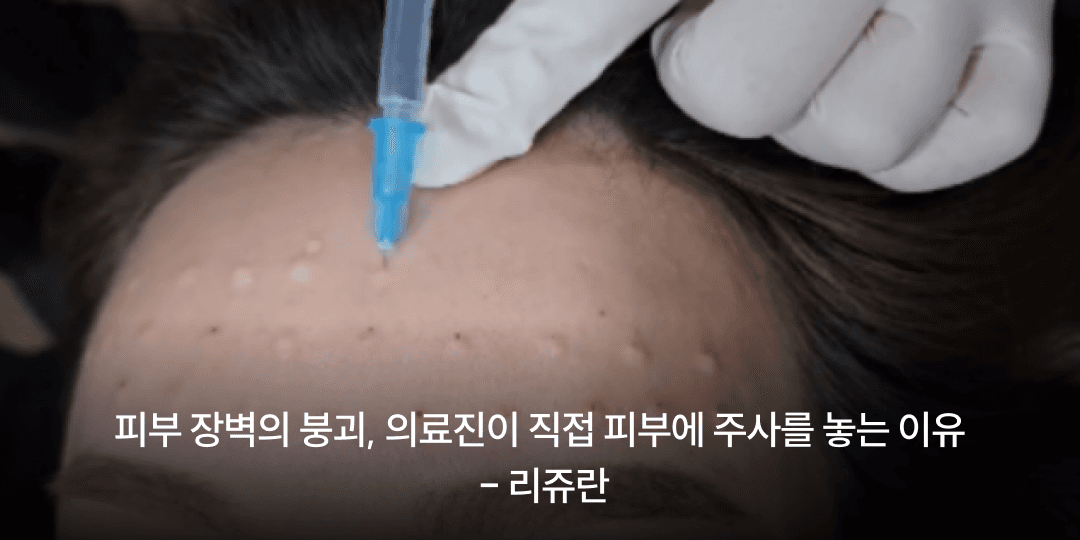
Clinical note: the cell regeneration effect is the strongest, but the pressure as the solution enters the dermis makes it the most painful. Embossing — raised bumps at the injection sites — inevitably follows, and the thinner the patient's skin, the longer it lasts, up to three or four days.
A clinical example: our senior practitioner has very thin, extremely sensitive skin with melasma — a classic case of barrier damage. For her we inject original Rejuran precisely into both cheeks every other month to build the thickness of the dermis itself, with a very positive course for sensitive skin.
Made for the thinnest, most sensitive areas — around and under the eyes. One 1cc syringe per box.
Composition: smaller particles and a thinner formulation than the original.
Clinical note: because the formulation is thinner, injection is markedly less painful than standard Rejuran, and the embossing settles quickly. However, the under-eye area has dense fine vessels and extremely thin skin, so bruising is very likely.
A caution: Rejuran Eye is excellent for fine lines under the eyes and for firmness in thinning skin around them, but temporary bruising can follow. So if you have an important shoot, meeting or wedding coming up, please allow at least two weeks.
Designed for patients who want Rejuran's regenerative effect but hesitate because of the pain. Commonly available in 1cc.
Composition: it contains the local anaesthetic lidocaine, along with domestic hyaluronic acid (HA).
Clinical note: because the lidocaine acts immediately as the solution spreads after the needle enters, pain is markedly lower than with the original. It is an excellent alternative for those sensitive to pain who had considered sedation, or who want to minimise the stress of the procedure.
To resolve severe dryness at the change of season, dense hydration (HA) has to be supplied alongside regeneration (PN).
For hydrating injections we use a product with established safety and moisture retention.
Volume and technique: it comes in a generous 5cc vial. We draw and divide precisely the amount needed according to the patient's dryness and the area to be treated.
Synergy: the best course usually comes from laying the foundation of regeneration across the whole face with Rejuran Healer, then layering the hydrating injection densely into areas that lack moisture particularly — the forehead, around the mouth.
A clinical example: on our treatment day, for one of our practitioners we injected standard Rejuran into both cheeks to build the barrier, and placed the hydrating injection point by point into the forehead, where fine lines form readily and dryness is pronounced. The volume of moisture filling from within the skin was visible immediately.
"No pain, no gain."
This is what I always say, in my halting English, to the international patients who come to us.
Whether Rejuran or a hydrating injection, placing a needle into the dermis and injecting a viscous solution does involve discomfort.
Even with plenty of anaesthetic cream, the deep aching sensation cannot be removed entirely.
But the reason so many patients — and our own team — return to these treatments regularly, accepting that temporary discomfort, a few days of embossing or slight bruising, is that they open a route to regeneration the skin cannot manage on its own.
However good the cream applied to the surface, less than 1% reaches the dermis past the thick stratum corneum and the epithelial barrier.
A skin booster, placing active ingredients accurately within the dermis by injection, is the fastest and most reliable medical solution for restoring a skin environment broken down at the change of season.
If itching, redness or cracked dryness are causing you stress, please do not struggle with it alone.
If you are afraid of the pain, we can minimise the discomfort with the HB product or by adjusting the anaesthesia carefully — so please take courage and come for a consultation.
Having experienced and verified both the discomfort and the results ourselves, we will repay that with careful, precise treatment. Thank you.
Our medical team will advise you based on your skin condition.