Beard areas are dense and coarse, so sessions and intervals differ. How laser hair removal works, how often it is needed, and what to avoid before and after.
Written and reviewed by Dr. Lee Yumin, MeSOnBom Clinic
Hello. This is Dr. Lee Yumin of MeSOnBom Clinic.
Men often describe shaving as a chore that has to be repeated every day.
Shave cleanly in the morning and dark stubble is back by the afternoon; for many, the repeated contact of the blade leaves the skin red or irritated.
In the changing seasons, when the skin turns dry, the tightness and irritation after shaving can be more pronounced.
To reduce this discomfort, more and more men are looking into laser hair removal.
In this piece I want to explain why men's hair removal is particularly uncomfortable and why it takes longer, along with how it works, how many sessions are needed, and what to observe before and after treatment.
The underlying principle is the same.
The areas usually treated, and the coarseness and density of the hair, differ, however, so the treatment plan can differ too.
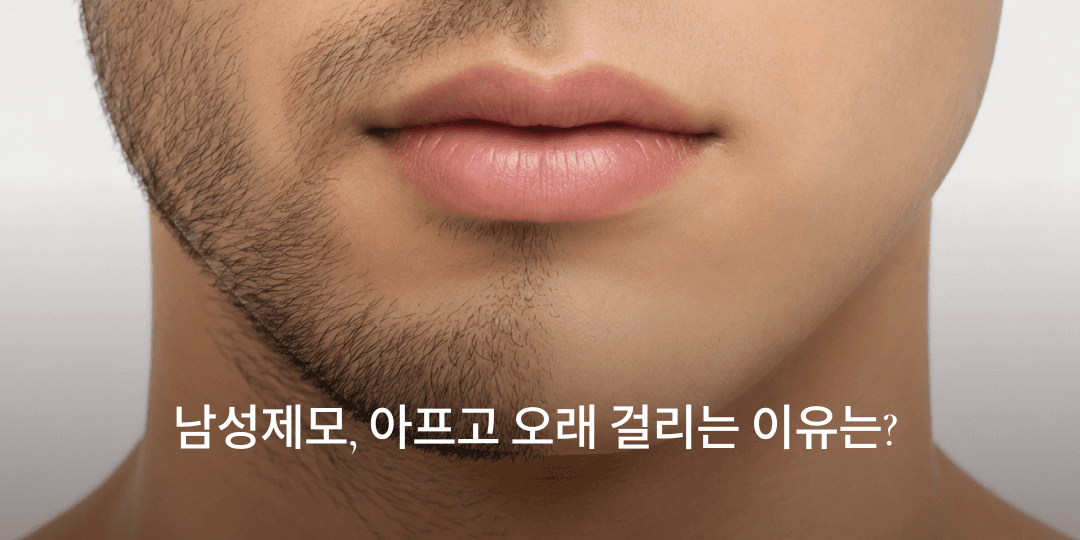
The upper lip, chin and under the chin, where men most often want hair removed, tend to carry a lot of hair.
These areas need careful observation of the skin's response during laser delivery, and can require more sessions than typical hair removal areas.
That does not mean men's hair removal is always carried out at high energy.
The laser's energy, the speed of delivery and the cooling method must all be adjusted carefully to the skin's response, after assessing skin colour, the coarseness and density of the hair, and the area being treated.
Laser hair removal delivers heat to the follicle using light energy absorbed by the melanin in the hair.
Hair cycles repeatedly through growth, regression and resting phases, and the laser responds mainly to hair in the growth phase.
Because not all hairs are in the growth phase at the same time, repeated treatment is needed to reduce the overall amount of hair.
Dark, coarse hair responds relatively well, while white or grey hair with little melanin can respond only to a limited degree.
Skin colour and any tanning must also be assessed.
Where the skin is dark or considerably sun-tanned, an appropriate wavelength and energy must be applied in light of the risk of burns or pigment change.
Beard hair removal is carried out at intervals of about four to six weeks at first, and as the amount of hair decreases and regrowth slows, the intervals are gradually extended.
The number of sessions differs not only with the coarseness and density of the hair and the condition of the skin, but also with how much reduction is wanted.
Rather than fixing a number of sessions at the outset, the next appointment should be set while observing the change in the amount of hair and the rate of regrowth after each treatment.
Laser hair removal is also closer to the concept of permanent reduction — reducing the number and coarseness of regrowing hairs over the long term — than to removing hair entirely.
Some hair can regrow after treatment, and maintenance sessions can be needed depending on the individual.
Before treatment, do not pull hair out by waxing or with tweezers — tidy it with a razor only.
Avoid excessive tanning and strong ultraviolet exposure, and tell the medical team during consultation about any medication you are taking or any skin condition you have.
After treatment, redness, warmth and stinging can appear temporarily, so it is best to avoid hot baths, saunas, alcohol and vigorous exercise until the irritation settles.
Moisturiser and sunscreen should also be used carefully so the skin can recover fully.
Rarely, blistering, pigment change or paradoxical hypertrichosis — fine hair becoming coarser — can occur.
If an adverse reaction persists or the discomfort worsens, do not treat it yourself; have it assessed at a medical facility.
Q. Is beard hair removal very painful?
A. In areas carrying a lot of hair, such as the upper lip and chin, a momentary sting or the sensation of an elastic band snapping can be felt relatively strongly. Depending on the level of discomfort, cooling methods or anaesthetic cream can be applied.
Q. Can I shave straight after treatment?
A. If warmth or redness remains in the skin, it is better not to shave immediately. Shave with a clean razor once the skin has settled, and take care not to go over the same area repeatedly.
Q. Does it help with shaving irritation?
A. As the coarseness and density of the beard decrease, it can help to reduce how often you shave and the irritation placed on the skin. Hair removal alone does not treat folliculitis or acne that has already developed, however, so if inflammation recurs the cause should be established first.
A set number of sessions and a set intensity do not apply identically to everyone.
A plan suited to the individual should be built by assessing skin colour, the coarseness and density of the hair, and how much reduction is wanted.
If repeated shaving and dark stubble are causing you discomfort, I suggest establishing the present condition of your skin and hair first.
Written by Dr. Lee Yumin — MeSOnBom Clinic
Our medical team will advise you based on your skin condition.