Age spots are seborrheic keratosis, driven mainly by UV exposure. On CO2 laser removal, hydrocolloid aftercare and prevention.
Hello. This is Dr. Lee Yumin, medical director of MeSOnBom Clinic.
Fine dust obscures the view now and then, but on the whole the weather is lovely.
There is still a cold snap and some wind, but seeing cherry blossom, cornelian cherry and forsythia in full bloom around the neighbourhood lifts the spirits.
As it warms, many more people are out hiking, playing golf or tennis.
It is a fine season to be outdoors, but as a doctor who treats skin there is one thing I want to stress at this time of year.
UV light, to which we are exposed unprotected.
Those who come to the clinic regularly tend to be thorough about basic skincare and sun protection, and their skin is in excellent condition.
Unfortunately, quite a few others only come once a pigment condition has settled deeply after years of leaving the skin exposed.
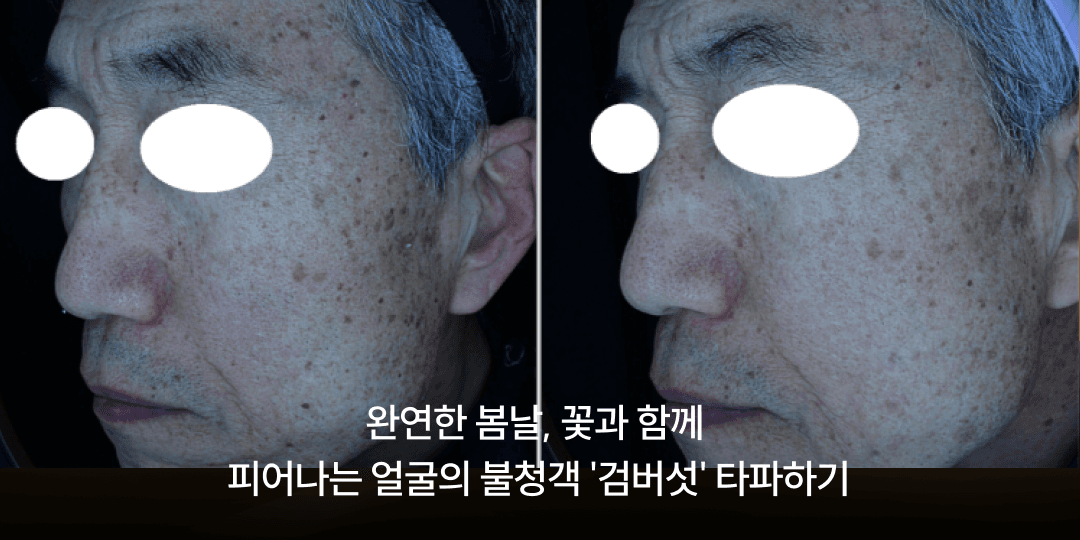
The most representative of these unwelcome guests is the age spot.
The precise medical name for what we call an age spot is seborrheic keratosis.
It is a benign growth arising from excessive proliferation of keratinocytes in the epidermis.
Early on it can look like a small pigmented patch, but over time it turns brown or black, rises above the skin surface and becomes rough to the touch.
It becomes more frequent from the forties onward as skin ageing sets in, and UV exposure is considered the greatest cause.
For that reason it concentrates on areas not covered by clothing and exposed directly to sunlight — the face, the backs of the hands, the arms.
A considerable proportion of the age spot patients I meet are middle-aged men or older.
Many had little interest in skincare, or strongly disliked applying sunscreen because of the sticky feeling.
Among those who drive long distances for work, or enjoy golf, tennis or hiking, melasma and age spots very often sit like medals on the side of the face that takes the most sun.
One man in his mid-forties who came to us had pigment conditions across his whole face because of long hours driving, and told me he had never once used sunscreen in his life because he disliked the heavy feeling.
There is another situation I meet often in clinic.
Fathers arriving in a hurry just before a child's wedding or a meeting between families.
Having laughed it off for years — "spots and age spots come with getting older" — they arrive days before an important occasion, pushed along by wife and children.
But dermatological treatment is not magic.
Removing pigment and letting new skin grow takes a physical amount of time.
However much I explain that new skin needs time, some are upset that it is not clear immediately — so if you have an important date coming up, please do come at least two months beforehand.
Age spots that have already formed cannot be resolved with cosmetics or home remedies; physical removal is required.
In dermatology we mainly use the CO2 laser.
It works by using a wavelength absorbed by water to vaporise skin tissue precisely.
Only the raised lesion is selectively and precisely removed.
Treatment usually takes one to two minutes per lesion, though larger or deeper ones can take five minutes or more.
To reduce discomfort we apply a local anaesthetic cream, or for larger lesions add a light injected anaesthetic so the treatment is comfortable.
A successful treatment is not the end of the process.
The area where the lesion was removed is effectively a graze, so aftercare must be thorough to let it heal cleanly without complication.
After laser treatment we apply a hydrocolloid dressing to the wound.
It absorbs exudate and maintains a moist environment that promotes cell regeneration, while blocking bacteria and UV light — a very important role.
There are common misunderstandings about this dressing.
It does not need changing daily: many replace it once a day because it comes off while washing or looks untidy. But changing it only when the exudate is so heavy that the dressing swells white and can hold no more — usually every two to three days — is far better for regeneration.
The longer you keep it on, the better: recovery speed differs with the size and depth of the wound. We usually recommend at least two weeks, and if the lesion was larger than 1cm, keep it on generously for more than two weeks until the wound has healed fully and the redness has gone. Removing the tape too early because it feels restrictive exposes the area to UV light and can leave pigmentation, so please take care.
Age spots cannot be prevented completely, but attention to sun protection alone can greatly delay their appearance and prevent them worsening.
Always apply sunscreen before going out, and reapply every three hours during outdoor activity to maintain the effect.
Stick and cushion formats that do not get on the hands are now widely available, so men can use them without reluctance.
We recommend SPF 30 or higher and PA+++ or higher.
Some people say sunscreen stings their eyes so badly they cannot use it.
This is usually because chemical filters irritate the eye mucosa or cause an allergic reaction.
For them I recommend a mineral (physical) sunscreen, which forms a thin film that reflects light.
Sunscreens made for babies and children in particular exclude irritating ingredients, so they can be applied safely right up to the eye area without stinging.
The most direct and reliable method is to block the sunlight physically.
Wearing a wide-brimmed hat, or a UV mask that covers the whole face, is the most complete protection I can recommend as a doctor.
It may feel odd at first, but they are thin and breathable and you soon get used to them.
On long drives, the arms and backs of the hands are exposed to UV light through the window, so it is worth getting into the habit of wearing long sleeves or driving gloves.
Age spots may be part of the natural process of ageing, but with a little attention they can be prevented and treated cleanly.
Before the sun grows hotter, please take good sun protection habits with you when you go out with the people you love.
I hope you enjoy the warm spring with healthy, clear skin. Thank you.
Our medical team will advise you based on your skin condition.