Four chemical exfoliants compared: water-soluble AHA and PHA, oil-soluble BHA and LHA, and which skin types each suits.
Hello. This is Dr. Lee Yumin of MeSOnBom Clinic.
Today I want to talk about peels, which we encounter readily in everyday life.
Products that remove dead skin cells are generally called peels, and they divide into two kinds.
Physical peels: scrubs, gommage gels and similar. (The treatment we perform with carbon gel also belongs here.)
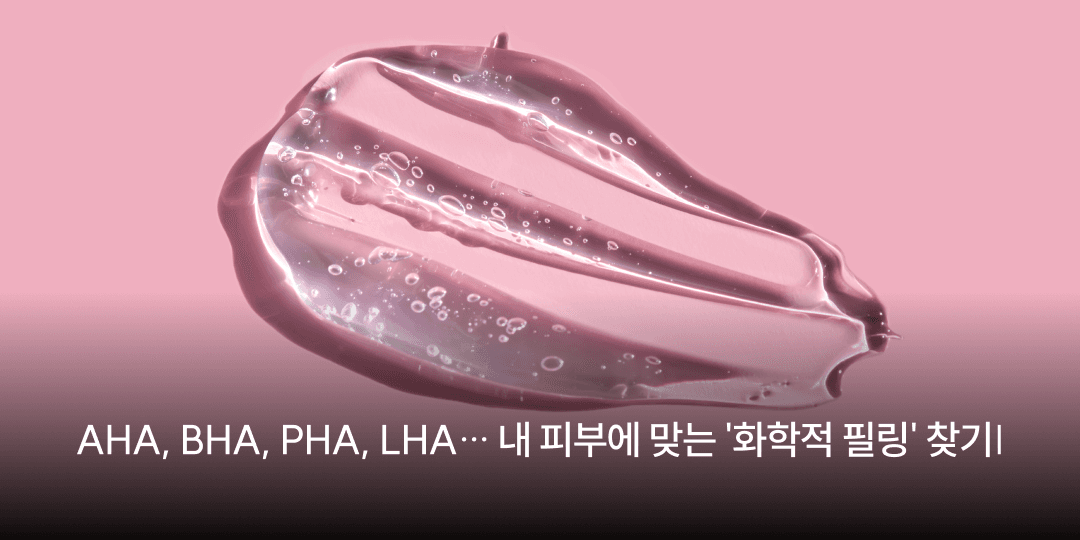
Chemical peels: dissolving dead skin with active ingredients — the familiar AHA, BHA, PHA and LHA.
This may sound complicated, so today let us look closely at the four kinds of chemical peel.
Types: glycolic acid, lactic acid, malic acid, tartaric acid and citric acid are common. (The molecules grow larger further along that list.)
Characteristics: carrying an OH group, they are water-soluble. Glycolic acid, the most common in cosmetics, dissolves dead skin well, but its small molecular weight means it penetrates quickly, causing more irritation (stinging if left on) and some dryness.
Recommendation and cautions: cosmetics are usually below 10% acidity, so it is best to start low. Where possible I recommend lactic or citric acid, which have larger molecules, absorb more slowly and are less drying. Use a low concentration (under 10%), and I prefer leaving it on for about five minutes before rinsing with water. It also causes photosensitivity, so thorough sun protection is essential.
Types: salicylic acid is the most representative.
Characteristics: with a benzene ring in its structure it is oil-soluble. It adheres well to sebum inside the pores and dissolves it. Salicylic acid, which is also the raw material for aspirin, has an anti-inflammatory action on the skin and partly helps calm inflammation in acne-prone skin.
Recommendation and cautions: unlike AHA products it is usually used at low concentration, and is not known to cause particular photosensitivity. I recommend limited use on areas with heavy sebum — the nose, the cheeks, between the brows.
Types: gluconolactone, lactobionic acid and maltobionic acid.
Characteristics: water-soluble like AHA. It was developed to address the irritation and dryness caused by AHA's small molecules, and its molecular weight is very much larger. Because of that it absorbs slowly with little dryness or stinging, so it can be used on sensitive skin.
Recommendation and cautions: rather than leaving PHA products on the skin for long, I recommend applying for about five minutes, rinsing with water and then moisturising thoroughly.
Types: capryloyl salicylic acid is most used.
Characteristics: as the name suggests it resembles BHA. With a long fatty acid tail attached to the benzene ring, it is oil-soluble. Its structure gives it a fairly large molecular weight, so absorption is slow, and being weakly acidic (pH 5.5) it causes very little irritation.
Recommendation and cautions: mild in character with a moderate acidity, it can be used comfortably on both oily and dry skin.
AHA: good at removing dead skin, but watch for irritation and dryness (sun protection essential)
BHA: oil-soluble, recommended for inflammatory and acne-prone skin in the T-zone and other oily areas
PHA: large molecules, little irritation, hydrating (recommended for sensitive skin)
LHA: slow absorption, very low irritation, weakly acidic (suitable for both oily and dry skin)
Chemical exfoliants act differently on the skin according to their molecular size and character.
Please choose the ingredient that suits your skin type and concern, and use it safely and correctly. Thank you.
Our medical team will advise you based on your skin condition.