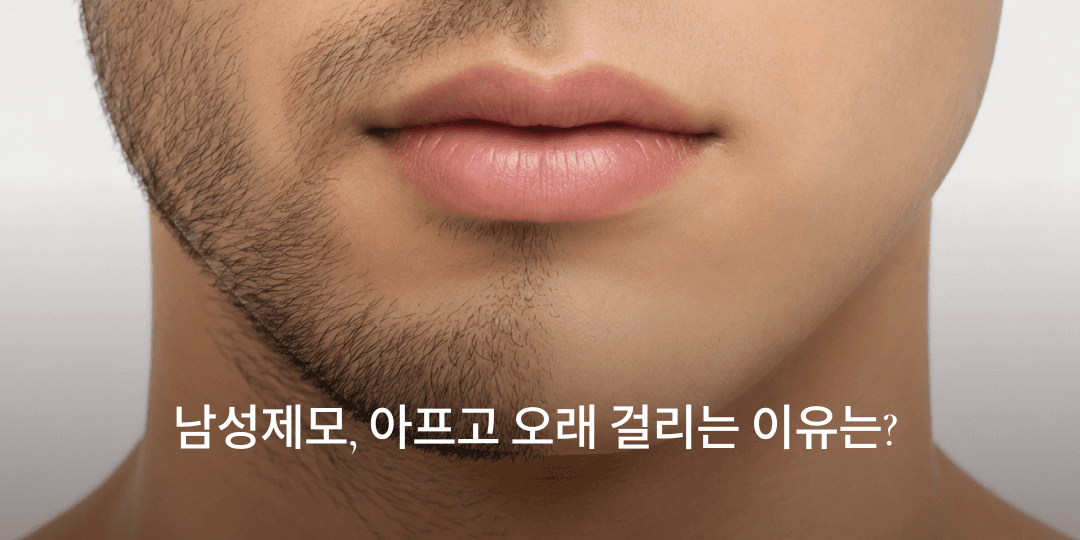
Beard hair is thick with deep follicles. Combining 755nm and 1064nm reaches both shallow and deep follicles, reducing patchy results.
Hello. This is Dr. Lee Yumin of MeSOnBom Clinic.
One of the greatest daily nuisances men face in front of the mirror is shaving.
However carefully you shave in a rushed morning, stubble showing by the afternoon makes a clean impression hard to keep.
Frequent use of a razor also damages the skin barrier and becomes a main cause of chronic problems such as folliculitis and redness.
More and more men decide on laser hair removal to escape that nuisance and stress.
But quite a few are disappointed afterwards by a result that differs from what they expected.
The complaints I hear most in clinic come down to three.
"Doctor, the beard isn't really clearing."
"It's cleared patchily and looks messier than before."
"The cheeks and jaw cleared, but the hair around the mouth is the only part left, like a stranger's moustache."
When I worked at another clinic using a single-wavelength hair removal laser, I thought hard about these complaints.
Why, with a device that is clearly good and widely used, were the results on men's beards so unsatisfying?
That frustration led me to study men's beard removal closely, almost obsessively.
Compared with women's body hair or hair elsewhere, men's beard hair is far thicker, and the follicle sits very deep in the skin.
The density is also very high, so laser energy is often dispersed before reaching the target, or fails to reach deep enough.
Simply firing a laser that appears powerful is therefore not enough.
What matters most is delivering energy accurately and evenly to the depth at which the follicle sits.
After testing a range of well-regarded lasers including GentleMax and Apogee over a long period and following the clinical course, the approach I arrived at is dual-wavelength treatment using a long-pulse laser.
At our clinic we use Clarity 2, which we found delivers output most evenly.
Rather than using a single wavelength, we use both 755nm and 1064nm to raise the completeness of the treatment.
755nm (alexandrite): absorbed well by melanin, it effectively destroys ordinary hair and follicles sitting shallow in the skin.
1064nm (Nd:YAG): penetrating deep into the skin, it is excellent at reaching the thick, deep-rooted follicles of a man's beard.
Used together, energy reaches everything from shallow hair to deep, thick hair without gaps.
In practice, adding the 1064nm wavelength not only produced results faster but also greatly reduced the persistent problems of patchy clearing and hair left only around the mouth.
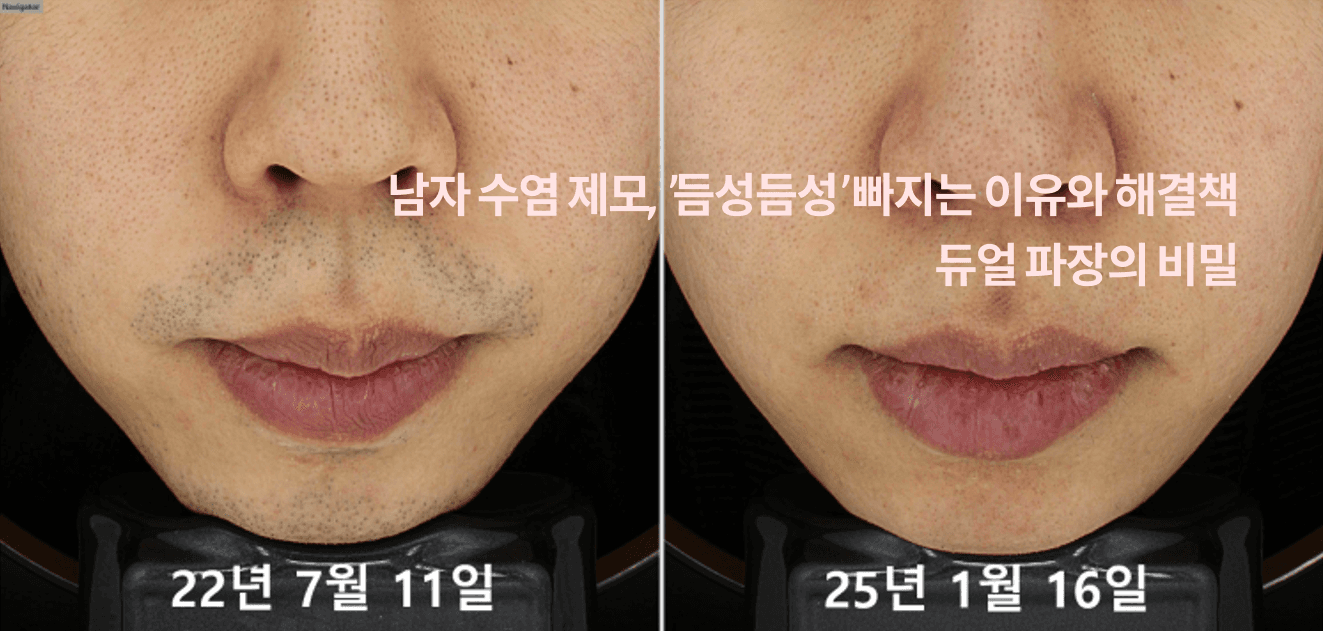
Looking at the course of patients who have had shaving-line removal (both cheeks, philtrum, lower jaw) with dual wavelengths, the difference is meaningful.
After around ten sessions, the density of hair from the sideburns through the philtrum to the jaw is noticeably reduced and the impression is much cleaner.
Those who have continued past twenty sessions, even attending irregularly, have reached the point where the shadow of the beard has almost gone and the nuisance of shaving is behind them.
Above all, with the daily physical irritation of the razor removed, the breakouts that troubled the jaw and philtrum improve and the skin texture itself gets better — which patients are extremely pleased about.
"What if I remove the beard entirely and regret it later?" This is the concern men raise most when first considering laser hair removal.
To them I suggest having just one session first.
Laser hair removal does not remove a beard permanently in one session.
Hair grows again in time, so if the result feels unfamiliar or different from what you imagined, returning to your previous state is no problem at all.
If you are under stress from the daily ordeal of shaving and from patchy remaining stubble, I hope dual-wavelength removal that takes follicle depth into account helps you find clean, smooth skin.
A deep understanding of the skin and the right choice of device are what make a satisfying result.
I will be back with more useful information next time.
Our medical team will advise you based on your skin condition.