Oligio delivers RF heat to the dermis to remodel collagen. Why individual design matters, and how cooling gas and vibration control discomfort.
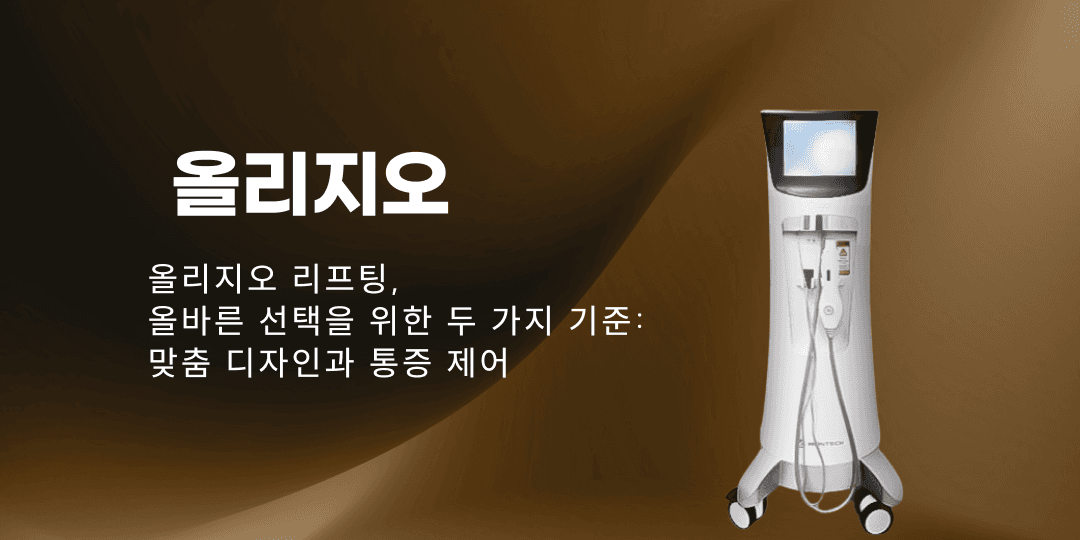
Oligio lifting: two criteria for choosing well — tailored design and pain control
Hello. This is Dr. Lee Yumin of MeSOnBom Clinic.
In current anti-ageing practice, radiofrequency lifting that supports collagen regeneration within the skin has become care anyone can access.
Among those treatments, Oligio has established itself as one of the standard approaches to RF firmness care, its effect and safety confirmed through years of accumulated clinical results.
The more widespread and easily available a device becomes, the more there are things you must check to get a satisfying result.
Those are a design matched to your own facial structure, and a pain control system that keeps the treatment safe.
Let me explain how Oligio acts within the skin, and what to consider beforehand.
Oligio protects the skin surface while delivering strong radiofrequency heat to the dermis, the deeper layer that determines firmness.
It works on the same medical principle as Thermage, the well-known premium RF treatment, generating heat deep in the skin to remodel its structure.
When RF energy reaches the dermis, collagen fibres that had loosened contract immediately.
As time passes after treatment, cells within the skin are stimulated and continue producing new collagen and elastin.
Through that process the density beneath the skin builds, fine lines improve, and enlarged pores and rough texture are smoothed.
One of Oligio's main strengths is that, unlike ultrasound (HIFU) lifting which can reduce the subcutaneous fat layer excessively, it targets the dermis, so there is less concern about hollowing of the cheeks.
But skin thickness, the direction of sagging and the amount of tissue in each area differ entirely from person to person, so a tailored approach by face shape and skin type is needed.
Little facial tissue with many fine lines: where the skin layer is thin, the energy must be adjusted carefully so that excessive heat is avoided. Shots are placed densely around areas that wrinkle readily, such as the eyes and mouth, to build density.
A jawline blurred by sagging cheeks: without reducing volume, the tissue of the jowls and the double chin line is drawn upward to encourage a smooth jawline.
Those who have had other treatments such as filler: where filler or a skin booster has been placed, we allow a settling period of about two weeks, then treat with the skin layers carefully distinguished so that the injected material is neither displaced nor lost and the treatments work together.
Oligio became an established firmness treatment because it controls the risks of pain and side effects scientifically.
Two safety systems work together so that patients stay comfortable even as strong RF energy is applied.
Intelligent cooling gas
To prevent surface burns during high-output RF treatment, cold gas is released momentarily before and after each application of energy.
While heat travels deep into the skin, the surface stays cool — lowering the risk of burns and greatly reducing the discomfort felt.
Micro-vibration
As the tip contacts the skin, a fine vibration is delivered alongside. This uses the principle that the body registers vibration faster than pain.
It disperses the pain signal reaching the brain effectively, so most treatments can be carried out comfortably without anaesthesia.
Paradoxically, the more widespread a treatment like Oligio becomes, the more the result and its duration depend on the practitioner's skill and attention to detail.
The device's performance is already established; what decides final satisfaction is how it is applied to each person's face shape and skin thickness.
So rather than choosing it lightly because it is common, I recommend a full consultation with a doctor who can analyse your facial structure accurately and build a precise treatment plan.
Our medical team will advise you based on your skin condition.