Instead of filler, Juvelook Volume induces your own collagen. The four treatment stages, the self-massage that prevents nodules, and real cases.
Hello. This is Dr. Lee Yumin of MeSOnBom Clinic in Hongdae.
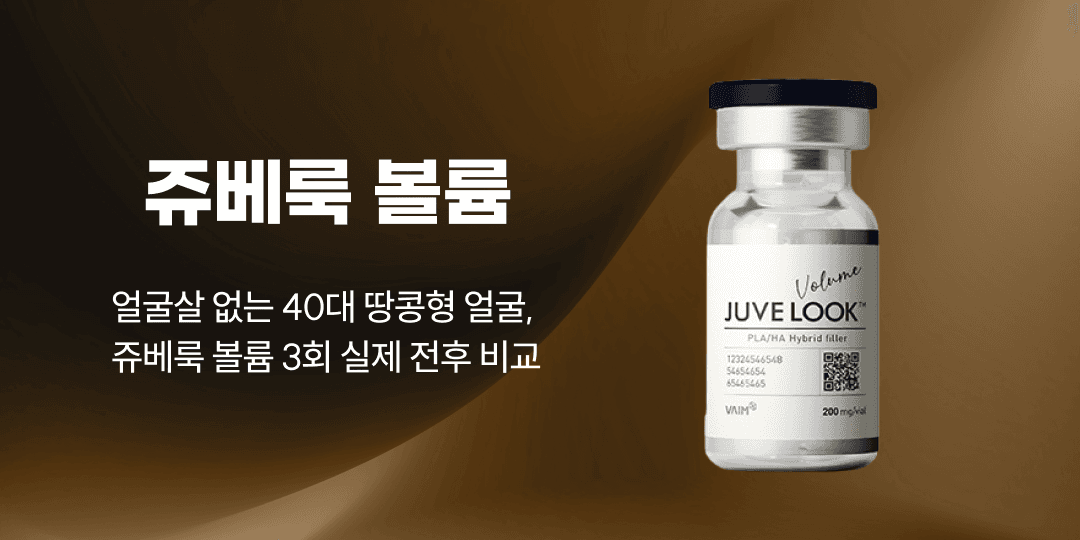
If you are troubled by a peanut-shaped face — uneven contours as facial fat is lost with age — Juvelook Volume, which generates your own collagen, can be an excellent alternative to filler.
Today I want to set out the four stages of the treatment, the self-massage that is key to preventing nodules, and real cases over three sessions.
Filler used to be the main treatment for areas that had lost volume, but in line with a preference for natural results, the collagen booster Juvelook Volume has become very popular.
With age the ligaments supporting the skin loosen, and while fat disappears from certain areas (the front and side of the cheek), it accumulates in others such as the jowls.
The facial line becomes uneven and the side of the cheek hollows — the so-called peanut-shaped face. Juvelook Volume goes into the areas where fat has been lost and induces natural collagen production.
Here I explain the pain and the process that patients ask about most, through an actual case treated at our clinic to improve a peanut-shaped face.
After Juvelook Volume, self-massage by the patient is absolutely necessary to reduce swelling quickly and prevent the solution clumping into nodules.
Duration: for five days after treatment.
Frequency: often, at roughly two-hour intervals.
Method: apply plenty of moisturiser, then press and rub firmly — firmly enough that it is slightly uncomfortable. The direction does not matter much; deep, pressing pressure is the point.
Recovery and precautions
Swelling: slight swelling for three to four days after treatment. (There is a phenomenon where the face looks better while slightly swollen.)
Dressing: we recommend keeping the small hydrocolloid dressing placed where the cannula entered for 24 hours.
Case 1 (mid-forties, a member of our staff): slim build with little facial fat. After three sessions, the deep nasolabial folds and hollow side cheeks were smoother, and volume in the front of the cheek had filled out roundly.
Case 2 (mid-forties, patient): naturally thin facial tissue. After three sessions the hollowing at the side of the cheek filled naturally and the overall contour softened.
Pain and swelling: it only hurts during the anaesthetic injection, not during treatment itself. Swelling accompanies it for a few days.
Number of sessions: results vary with each person's capacity to produce collagen. We usually recommend three sessions, though those with very little facial tissue to begin with may need more.
Growing older is a natural process, but we would all rather do it gracefully.
A safe, natural collagen volume treatment is worth considering.
Thank you for reading to the end.
Our medical team will advise you based on your skin condition.