The difference between PDRN and PN, why Rejuran hurts, and how Rejuran HB and the Eye line change the choice.
Hello. This is Dr. Lee Yumin of MeSOnBom Clinic.
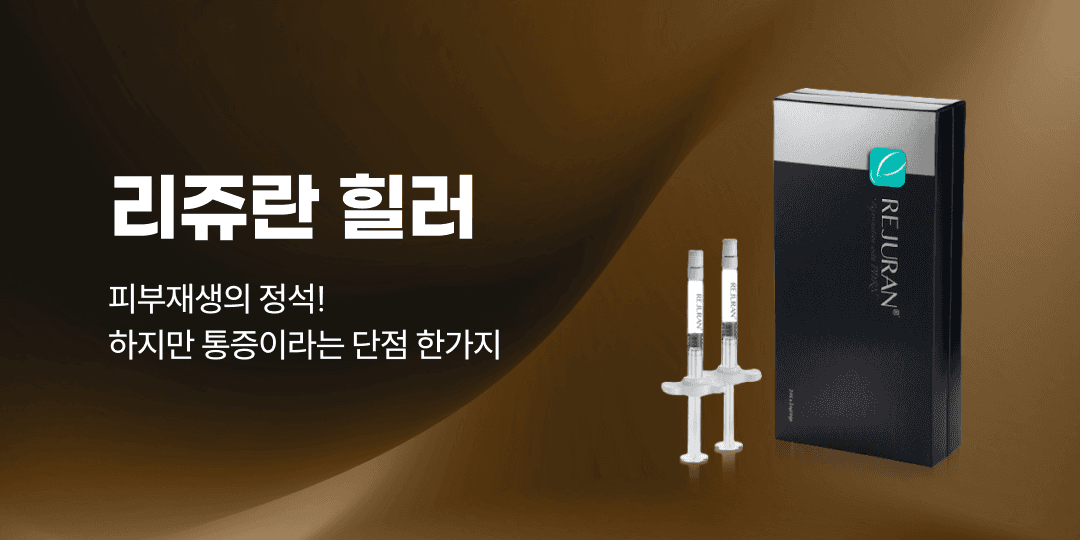
Anyone interested in skin anti-ageing and regeneration will have heard the name Rejuran Healer.
If you asked which skin booster is best known, Rejuran Healer would probably be the first mentioned.
But it is not famous for its results alone.
Unfortunately, it is also famous for the pain.
Today I want to share more detail about Rejuran.
From the difference between PDRN and PN, the key ingredients in skin regeneration, to how the barrier of pain that many people meet can be handled sensibly.
To understand how Rejuran works, it helps to know about PDRN (polydeoxyribonucleotide).
Extracted from salmon, it is excellent at supporting skin regeneration by proliferating epithelial cells and maturing the extracellular matrix.
It has long been used widely and safely for acne scar treatment and wound healing.
What we usually call Rejuran is made up of PN (polynucleotide).
It shares the same origin as PDRN, but with one decisive difference: the molecular weight is about three times greater.
Because the molecule is larger, it stays in the skin far longer and acts over a longer period.
That is also why the raised embossing marks on the skin surface after treatment last a while.
Thanks to that property, Rejuran goes beyond simple wound healing to create synergy across anti-ageing generally — improved firmness, smaller pores, softer fine lines.
A 2016 paper from Chung-Ang University Hospital studying women in their thirties and forties found the skin layer thickened and pigmentation, pores, wrinkles, tone and sagging all improved significantly.
That is the scientific basis for what long-term patients say: that the skin feels firmer, and different when the time for the next session comes round.
The difficulty is that the large, dense molecule makes injection considerably painful.
The ache as the solution goes in is greater than the needle itself, and in clinic I often see tears run down a patient's face regardless of their intention.
"Doctor, the anaesthetic doesn't seem to be working at all." "Doctor... is there much left?"
These are the questions I hear most during Rejuran treatment.
For the doctor performing it, that pain has always been a real problem to solve.
Rejuran HB (full name Rejuran HB Plus) emerged as an answer to that frustration.
Before recommending it to patients, I performed it on myself to check both result and pain.
The fine sting as the thin 33G nano needle enters remains, but the characteristic tearing pain as the solution spreads through the skin was almost absent.
Pain is felt differently by everyone, but in my case it felt about 80% less than standard Rejuran.
Feedback from patients treated recently agrees — they say the pain is slight compared with the Rejuran they have had before, and finish far more comfortably.
I am glad not to see people in tears from pain in clinic any more.
But HB is not automatically the best choice.
The right treatment differs with the area, the skin condition and what you want from it.
HB contains the anaesthetic lidocaine and HA, so the ingredients effective for skin regeneration are fewer than in Rejuran Healer.
If regeneration is your main aim, managing the pain with anaesthesia and choosing Rejuran Healer may give the better result.
If you are very sensitive to pain, HB can help; and because it contains HA, it is useful where you also want hydration and a dewy finish.
Around the eyes, where the skin is thin, the Rejuran Eye product gives a more satisfying result.
So we keep three options available for our patients.
Standard Rejuran: for those who tolerate pain well enough to have it without anaesthesia, or who prefer the original approach.
Rejuran HB: strongly recommended for those who want Rejuran's results but could not face the severe pain.
Rejuran Eye: used where fine targeting is needed for the thin, sensitive skin under and around the eyes.
Rejuran is without question an excellent skin booster.
It would be a shame to give up the chance of better skin out of fear of the pain.
Choosing HB to reduce pain is one good approach, and nerve blocks, anaesthetic cream and gas anaesthesia can also ease it — please ask at consultation.
Thank you for reading to the end. I hope today's information helps you. I will bring you more next time.
Our medical team will advise you based on your skin condition.