Cherry angiomas are benign proliferations of capillaries. Long-pulse laser clears each one in about a second, with no dressing needed.
Hello. This is Dr. Lee Yumin of MeSOnBom Clinic.
A considerable number of patients over thirty raise an unexpected skin change in clinic.
"Doctor, small red dots have appeared on my neck and chest — it isn't anything serious, is it?" they ask, looking anxious.
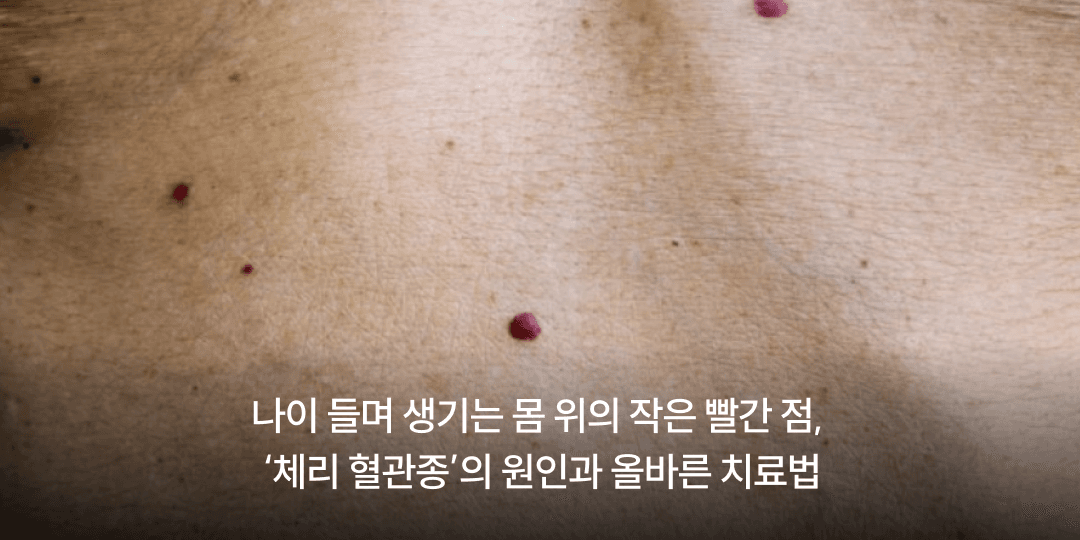
What are these tiny, vivid red dots you notice one day in the mirror or in the shower?
In my experience, 99% of such questions concern what is medically called a cherry angioma.
Also known as cherry haemangioma, it is a very common skin finding in adults and — to put the conclusion first — a completely benign growth that in almost all cases does no harm to health.
Let me explain in detail.
As the name suggests, they are a clear, ripe-cherry red.
Histologically, capillaries near the skin surface proliferate excessively and swell upward into a raised form.
They are usually very small, around 1mm, though they sometimes grow slowly or increase in number nearby.
So why do they appear? Unfortunately modern medicine has not established a clear, specific cause.
Clinical research and statistics point to ageing as the most likely and most general factor.
They usually begin to appear gradually from the thirties, becoming more frequent with age.
Just as wrinkles appear and firmness declines with time, vascular dots are one of the natural skin changes of growing older — an easier thing to accept once understood that way.
They can appear anywhere, but occur mainly on the trunk — the neck, chest, back and abdomen — and sometimes on the face and limbs.
They begin as very small flat red dots and become gradually raised and dome-shaped over time.
Most importantly, they have no potential to become cancerous, and do not indicate any internal condition or other abnormality.
They cause no symptoms such as pain or itching.
They are therefore not something that must be removed for reasons of health.
But when many appear on exposed areas such as the face, neck or collarbone, they can look untidy and cause psychological stress.
Patients mostly come to us not out of concern for their health but to feel better about their appearance.
Fortunately, treatment is very simple and direct.
With advances in laser technology, a long-pulse laser is now mainly used to destroy only the problematic vessel selectively while minimising damage to surrounding normal tissue.
The treatment finishes almost anticlimactically quickly.
Treating one dot takes only about a second.
When the laser is applied, the red lesion turns black immediately.
This is an entirely normal response, showing that the laser energy has been absorbed by haemoglobin in the vessel and the vascular tissue has coagulated.
The coagulated tissue then forms a thin crust, which usually comes away naturally during washing or showering after about a week. New skin grows where the crust was and the skin returns to normal.
After removing an ordinary mole you usually have to wear a hydrocolloid dressing for several days, which is a nuisance — but after laser treatment of a cherry angioma there is no need for an artificial skin or dressing.
Leaving the area alone without particular irritation is enough for recovery, so the return to daily life is very quick.
In the end, whether to treat a cherry angioma rests entirely on how you feel about it.
If a red dot is small and does not particularly trouble you, there is no need to treat it at all.
But if it catches your eye every time you look in the mirror, or the number has noticeably increased and causes you stress, do come in and have it resolved simply.
As with the venous lake on the lip I wrote about previously, cherry angiomas are often left untreated or assumed to be difficult, simply because the information is not widely known, even though treatment is this simple.
Unexpected changes in the skin with age come to everyone.
Another year older may not be welcome, but where a skin concern can be resolved as easily and safely as this, there is little to worry about.
If a small red dot has been a quiet worry, do have it assessed and recover clear skin with an easy mind. Thank you.
Our medical team will advise you based on your skin condition.