Pulsed-wave needle RF targeting the papillary dermis, why it differs from continuous-wave devices, and how it combines with pigment lasers.
Hello. This is Dr. Lee Yumin of MeSOnBom Clinic.
One of the concerns I hear most often in practice is melasma.
Among these, what is called vascular or refractory melasma — distributed like a band below the eyes, or laid over both cheeks like a mist — has long been a challenge for patients and doctors alike.
A good many people give up treatment after dozens of laser toning sessions without clear change, or experience a rebound in which the melasma darkens after treatment.
This clinic too had been treating at two-week intervals with a combination of pico laser and Clarity, but we were conscious of a limit: many patients were not seeing improvement at the pace they hoped for.
Out of the sense that something was missing from existing treatment alone, what drew my attention recently through conferences and seminars was dermal remodelling based on needle RF — and Sylfirm X in particular.
Introducing a device calls for caution.
Theoretical grounds are not enough, so I first ran a demonstration unit in the clinic for a week and applied it directly to a range of cases.
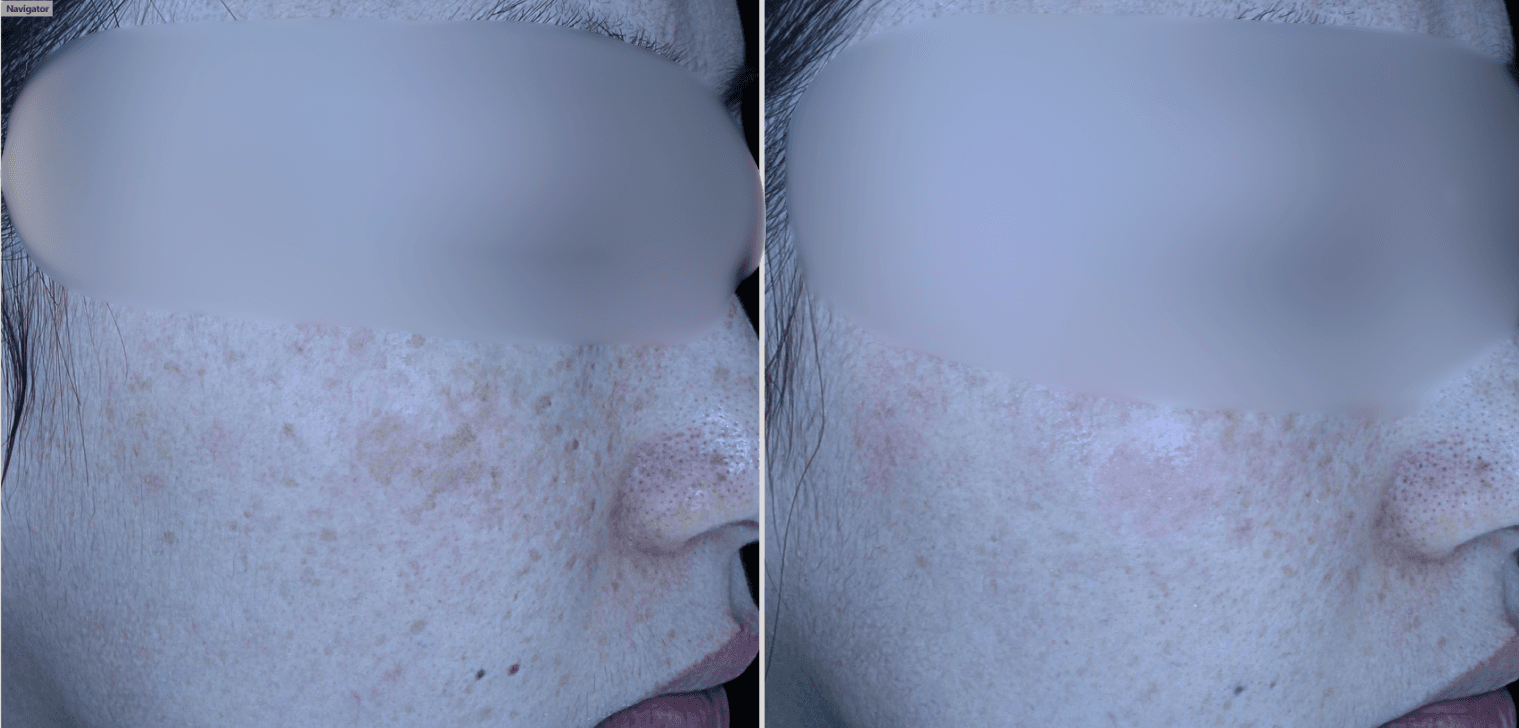
In particular, treating a member of our own staff in PW2 mode, visible improvement in facial redness was observed after a single session.
I used it in a number of other cases as well, and only after confirming both the academic evidence and the actual clinical results did I decide to introduce it.
A great many needle RF devices are now available in Korea.
Two things in particular distinguish Sylfirm X among them.
First, the way energy is delivered.
Most existing needle RF devices use continuous wave (CW) delivery.
This is effective for reducing pore size and treating scars, but the heat that accumulates as energy is delivered continuously can stimulate melanocytes.
When CW delivery is applied to skin with melasma, cases in which the melasma darkens through rebound — even at low energy settings — have been reported in clinical practice.
Sylfirm X adopts pulsed wave (PW) delivery, sending energy in discrete pulses.
This prevents excessive heat accumulation within the tissue and minimises unnecessary stimulation of melanocytes, even in sensitive skin with melasma.
From the practitioner's point of view, being able to apply it to patients with melasma with greater confidence is a considerable advantage.
Second, the precision of the treatment target.
Sylfirm X allows the treatment depth to be adjusted finely, so that the papillary dermis can be targeted accurately.
Recent research explains well why this matters.
A study published by Ajou University Hospital (Dermatologic Therapy, 2019) showed that Sylfirm X treatment alone had a meaningful effect on melasma, and research by Dr. Kim Hyung-moon (Journal of the Korean Society for Laser Medicine and Surgery, 2017) confirmed an effect even on melasma that had recurred after treatment.
The mechanism these studies share is that dermal remodelling through needle RF — in particular structural regeneration of the papillary dermis — is central to fundamental improvement in melasma.
The papillary dermis is the thin dermal layer adjoining the epidermis, and plays the most pivotal role in skin regeneration and barrier function.
The consensus in recent academic work is that without remodelling of this layer, surface treatment alone struggles to manage melasma effectively.
At this clinic we use Sylfirm X not simply as one more treatment device, but as the central axis of a combined treatment system based on precise diagnosis.
Before treatment, skin diagnosis allows a comprehensive assessment of the type and depth of the melasma, the presence of vascular dilatation, and the condition of pores and firmness.
On that basis we design a treatment combination optimised for each individual.
For refractory melasma, Sylfirm X is added to the pico laser and Clarity combination we have used previously, so that pigment treatment in the epidermis and dermal remodelling proceed together.
Working along both axes — breaking down melanin at the surface and regenerating structure at depth — allows a more three-dimensional approach to refractory melasma, where single treatments have had their limits.
We also actively recommend applying a regenerative booster such as PDRN (salmon DNA) or Rejuran immediately after Sylfirm X treatment.
The microchannels created by needle RF markedly increase transdermal absorption of the active ingredients.
Sylfirm X lays the groundwork of dermal remodelling while the booster promotes an environment for regeneration — the two work together.
Besides melasma, treatment can be tailored to concerns such as enlarged pores, acne scars and facial redness by varying the mode, energy level and needle depth.
Its practical advantages are also worth noting.
Because it targets the shallower dermis, discomfort during treatment is very low, so even those sensitive to discomfort can be treated without anaesthesia.
The temporary redness afterwards resolves within half a day, or a day at most, so the downtime burden is greatly reduced.
For those who have hesitated over active treatment because of discomfort or a long recovery, it can be a realistic alternative.
What must be said clearly is that there is no magic single answer for refractory melasma.
Sylfirm X is without doubt a powerful tool that addresses the limits of existing treatment, but consistent treatment and time are needed to feel a meaningful improvement.
It is also realistic to set the goal of treatment not at flawless skin, but at a condition where light makeup alone gives a natural, clear impression.
At this clinic we establish the skin's condition accurately through full consultation and diagnosis beforehand, and set realistic treatment goals together with the patient.
On that basis we design the optimal combination of treatments, including Sylfirm X, and hope to open a new possibility in treating melasma.
If long-standing melasma has worn you down, I hope you will come in for a consultation.
Thank you for reading.
Our medical team will advise you based on your skin condition.