Stubborn melasma is not solved by a season or a single laser. On vascular causes, tranexamic acid, Sylfirm and realistic goals.
Let go of the fantasy of flawless skin — this is when consistency matters | Treating stubborn melasma
Hello. This is Dr. Lee Yumin of MeSOnBom Clinic.
In consultations I meet many misunderstandings about skin conditions.
One of the most common is that melasma should be treated in winter, when UV light is weaker.
To put the conclusion first: that is half right and half wrong.
UV light does affect pigment conditions badly, but what decides whether melasma treatment succeeds is not the season — it is whether the patient has the time and the consistency to see it through.
Melasma sitting shallowly in the epidermis, the outermost layer, can improve noticeably in a relatively short time.
But the concerns patients bring to us are rarely that simple.
Naturally darker skin tones, skin with heavily developed capillaries and redness, or melasma spread in a wide band beneath the eyes or along the cheekbones — these are a different matter entirely.
Among Asian patients, including Koreans, many have stubborn melasma spreading beneath the eyes like a mask.
This tenacious form is never resolved by a short course of magical treatment, and the skin responds very slowly.
It requires a long course of regular, frequent visits, so it is best to begin when you can commit time and stay consistent.
To treat melasma effectively, it helps to know exactly what you are dealing with.
Melasma is not a condition with a single cause; it is more like an SOS from the skin, produced by several factors together.
The commonly known causes include strong UV exposure, genetic predisposition, hormonal imbalance from pregnancy or oral contraceptives, and natural skin ageing.
But the keywords dermatology has focused on most in recent research on stubborn melasma are blood vessels and underlying conditions.
As we age and the skin ages, the environment of the dermis changes, and abnormal capillaries often proliferate excessively.
Several recent studies have found that pigment conditions such as melasma tend to appear darker and wider along those over-developed vessels.
In other words, abnormal vessels act as a factory, continuously supplying and stimulating the melanocytes and worsening the melasma.
Studies also continue to report that endocrine conditions such as thyroid disease affect pigmentation directly or indirectly, so melasma should be understood not as a simple stain on the epidermis but as something reflecting the body's overall condition and ageing.
The difficult pigment conditions we call stubborn or vascular melasma can never be overcome with a single laser.
Beyond the conventional approach of targeting pigment alone, it needs a combined strategy that improves the environment of the dermis and stabilises the vessels behind it.
The importance of oral treatment (tranexamic acid):
Many patients are relaxed about laser treatment but strongly resistant to taking medication.
When I try to prescribe, many wave their hands and say they will never take medicine.
But oral tranexamic acid acts as an excellent booster in melasma treatment, particularly for stubborn cases.
It not only suppresses melanin production but also limits excessive vessel proliferation, so combined with laser treatment it reduces both the duration and the cost considerably.
For healthy younger patients without underlying conditions such as hypertension, diabetes or thrombosis, I recommend taking it under a specialist's assessment.
The strong synergy of pico, Genesis and Sylfirm:
For patients with stubborn melasma we mainly use a protocol combining pico laser, Genesis and Sylfirm (radiofrequency microneedling).
The pico laser breaks up existing pigment quickly and finely so it can be cleared, while the Genesis laser warms the dermis to support regeneration and calm redness.
The treatment I want to highlight here is Sylfirm.
If a patient had to choose only one of pico and Sylfirm because of cost or time, I would recommend Sylfirm without hesitation — that is how much I trust it.
Sylfirm delivers radiofrequency energy into the dermis through fine needles, selectively destroying the abnormal vessels behind the melasma and rebuilding the weakened basement membrane between epidermis and dermis.
For patients whose skin barrier has broken down, it does more than treat pigment — it remodels the overall environment of the skin.
Restoring the skin's foundation with skin boosters (PDRN, brightening injections):
For those whose skin barrier has been badly damaged by long-standing psoriasis or atopy, the ability to defend against outside stimuli is reduced and melasma rises more easily.
Alongside laser treatment, these patients need regular brightening injections containing tranexamic acid, or PDRN (salmon DNA) treatment which is excellent at regenerating damaged tissue, to rebuild the skin's basic resilience.
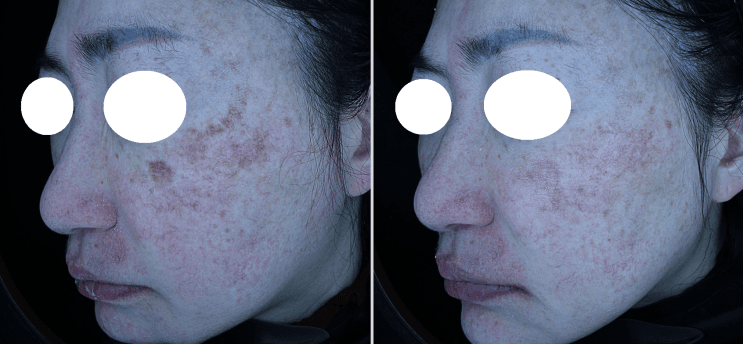
I would like to describe a woman in her mid-forties whom I met in clinic.
From her thirties, capillaries had begun to develop redly across her face, and severe, dark melasma had settled widely along those vessels.
It was an unfortunate case in which I saw directly, in clinic, the medical hypothesis I described earlier — that melasma develops readily where vessels develop.
To make matters worse, because she had underlying hypertension and diabetes, I could not prescribe the oral tranexamic acid that is so effective for melasma.
Hers was a difficult road to be taken with lasers and skin boosters alone, without the help of medication.
But she had the most powerful tool of all, the consistency I keep emphasising.
She came in faithfully every two to three weeks and had combined pico laser, Genesis and Sylfirm treatment.
She also had regular tranexamic acid injections and PDRN injections to repair a skin barrier damaged by a history of psoriasis.
What was the result?
Her melasma is now noticeably lighter and her skin tone markedly clearer.
But what I want to stress here is not how dramatic the result is — it is the time.
The interval between her first photograph and the later one was exactly one year.
Treating stubborn melasma without medication because of underlying conditions took a full year of time and patience.
There are questions patients ask most often.
"Doctor, how many pico laser sessions until the melasma is completely gone?"
"After treatment my face will be as clear as a baby's, won't it?"
As a doctor, those questions weigh on me.
I understand how earnestly patients feel, but I tell them the truth plainly.
Even if, like the patient above, you attend diligently for a year and receive every good treatment a clinic can offer, you cannot return completely to the flawless skin of your teens or twenties.
One of the strongest and most fundamental causes of melasma is, unfortunately, ageing.
Just as lines appear and hair greys with age, skin that has withstood years of UV light and outside stimuli leaves traces such as melasma and age spots.
We cannot turn back time.
Ageing is not an illness to be prevented; it is a natural part of life to be accepted.
So in approaching melasma treatment we should set aside perfectionism and set realistic, sound goals.
The final goal I always ask patients to hold is this: that with a light BB cream or foundation, the melasma is reasonably covered and the overall tone looks clean.
Even that degree of improvement raises quality of life remarkably and greatly reduces the stress of going out.
Letting go a little of the fixation on flawless skin makes the treatment itself far less stressful and much easier to sustain.
Treating stubborn melasma is a marathon run by doctor and patient together.
Home care matters as much as professional treatment at the clinic.
In cold, dry weather in particular, the skin barrier is easily damaged and conditions are ideal for pigment conditions to worsen.
So please pay particular attention to hydration. There is no need for expensive cosmetics.
Using an easily available sheet mask once a day and applying moisturiser more generously than usual, so the skin never has a chance to dry out, is an excellent extension of treatment that protects the barrier.
Melasma is not a stain that can be wiped away at once.
But if you set aside impatience and keep up steady treatment and care, your skin will repay you with clarity and health.
Please drink water often and look after your moisture today. Thank you.
Our medical team will advise you based on your skin condition.